
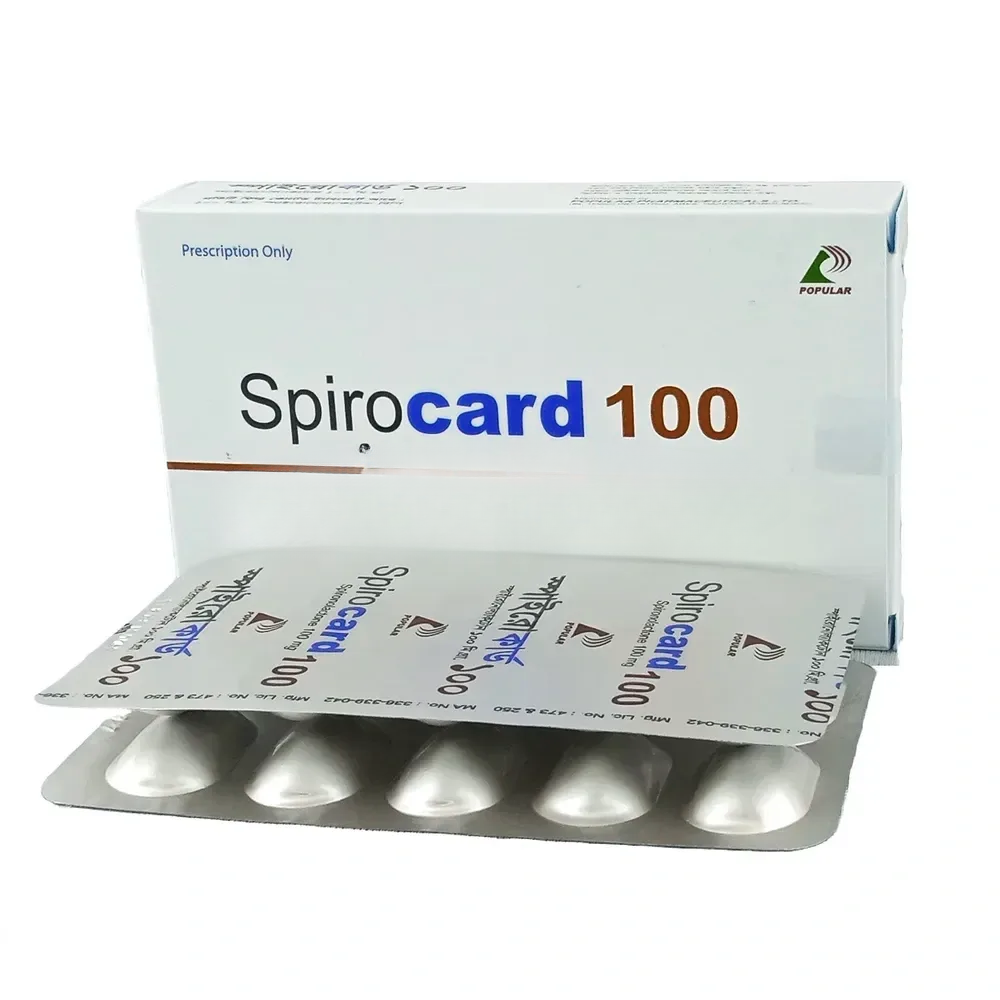
Spirocard
Tablet
Generic Name
Spironolactone
Strength
100 mg
Manufacturer
Popular Pharmaceuticals Ltd.
Unit Price
Unit Price: ৳ 20.00 (3 x 10: ৳ 600.00) Strip Price: ৳ 200.00
Unit Price: ৳ 20.00 (3 x 10: ৳ 600.00) Strip Price: ৳ 200.00
✅ In Stock
per unit · Bangladesh
🛒 Buy Now
🔒 Secure checkout · Return & Refund Policy
🔹 Indications
Spirocard is indicated for the management of edema and ascites in cirrhosis of the liver, malignant ascites, nephrotic syndrome, congestive heart failure and primary hyperaldosteronism.
🔹 Pharmacology
Description: Spironolactone is an antagonist of aldosterone & potassium-sparing diuretic. It acts primarily through competitive binding of receptors at the aldosterone dependent sodium-potassium exchange site in the distal convoluted renal tubule. Spironolactone causes increased amounts of sodium and water to be excreted, while potassium and magnesium is retained.
Mode of action: Spironolactone and its active metabolites are specific pharmacologic antagonists of aldosterone, acting primarily through competitive binding of receptors at the aldosterone-dependent sodium-potassium exchange site in the distal convoluted renal tubule. Spironolactone causes increased amounts of sodium and water to be excreted, while potassium is retained. Spironolactone acts both as a diuretic and as an antihypertensive drug by this mechanism. It may be given alone or with other diuretic agents that act more proximally in the renal tubule.
Absorption: The mean time to reach peak plasma concentration of spironolactone and the active metabolite, canrenone, in healthy volunteers is 2.6 and 4.3 hours, respectively. Effect of food: Food increased the bioavailability of spironolactone (as measured by AUC) by approximately 95.4%. Patients should establish a routine pattern for taking Spironolactone with regard to meals.
Distribution: Spironolactone and its metabolites are more than 90% bound to plasma proteins.
Metabolism: Spironolactone is rapidly and extensively metabolized. Metabolites can be divided into two main categories: those in which sulfur of the parent molecule is removed (e.g., canrenone) and those in which the sulfur is retained (e.g., TMS and HTMS).In humans, the potencies of TMS and 7-a-thiospirolactone in reversing the effects of the synthetic mineralocorticoid, fludrocortisone, on urinary electrolyte composition were approximately a third relative to spironolactone.
Elimination & Excretion: The mean half-life of spironolactone is 1.4 hour.The mean half-life values of its metabolites including canrenone, 7-a-(thiomethyl) spirolactone (TMS), and 6-B-hydroxy-7-a-(thiomethyl) spirolactone (HTMS) are 16.5, 13.8, and 15 hours, respectively. The metabolites are excreted primarily in the urine and secondarily in bile.
Mode of action: Spironolactone and its active metabolites are specific pharmacologic antagonists of aldosterone, acting primarily through competitive binding of receptors at the aldosterone-dependent sodium-potassium exchange site in the distal convoluted renal tubule. Spironolactone causes increased amounts of sodium and water to be excreted, while potassium is retained. Spironolactone acts both as a diuretic and as an antihypertensive drug by this mechanism. It may be given alone or with other diuretic agents that act more proximally in the renal tubule.
Absorption: The mean time to reach peak plasma concentration of spironolactone and the active metabolite, canrenone, in healthy volunteers is 2.6 and 4.3 hours, respectively. Effect of food: Food increased the bioavailability of spironolactone (as measured by AUC) by approximately 95.4%. Patients should establish a routine pattern for taking Spironolactone with regard to meals.
Distribution: Spironolactone and its metabolites are more than 90% bound to plasma proteins.
Metabolism: Spironolactone is rapidly and extensively metabolized. Metabolites can be divided into two main categories: those in which sulfur of the parent molecule is removed (e.g., canrenone) and those in which the sulfur is retained (e.g., TMS and HTMS).In humans, the potencies of TMS and 7-a-thiospirolactone in reversing the effects of the synthetic mineralocorticoid, fludrocortisone, on urinary electrolyte composition were approximately a third relative to spironolactone.
Elimination & Excretion: The mean half-life of spironolactone is 1.4 hour.The mean half-life values of its metabolites including canrenone, 7-a-(thiomethyl) spirolactone (TMS), and 6-B-hydroxy-7-a-(thiomethyl) spirolactone (HTMS) are 16.5, 13.8, and 15 hours, respectively. The metabolites are excreted primarily in the urine and secondarily in bile.
🔹 Dosage & Administration
Heart Failure: Initiate treatment at 25 mg once daily
Hypertension: Initiate treatment at 25 to 100 mg daily in either single or divided doses
Essential hypertension: For adults, an initial daily dosage of 50 to 100 mg of Spironolactone administered in either single or divided doses is recommended.
Primary hyperaldosteronism: Spironolactone may be employed as an initial diagnostic measure to provide presumptive evidence of primary hyperaldosteronism while patients are on normal diets.
Edema in adults (congestive heart failure, hepatic cirrhosis, or nephrotic syndrome): An initial daily dosage of 50-100 mg of Spironolactone administered in either single or divided doses is recommended, but may range from 25 to 200 mg daily.
Hypokalemia: Spironolactone in a dosage ranging from 25 mg to 100 mg daily is useful in treating a diuretic-induced hypokalemia, when oral potassium supplements or other potassium-sparing regimens are considered inappropriate.
Hypertension: Initiate treatment at 25 to 100 mg daily in either single or divided doses
Essential hypertension: For adults, an initial daily dosage of 50 to 100 mg of Spironolactone administered in either single or divided doses is recommended.
Primary hyperaldosteronism: Spironolactone may be employed as an initial diagnostic measure to provide presumptive evidence of primary hyperaldosteronism while patients are on normal diets.
Edema in adults (congestive heart failure, hepatic cirrhosis, or nephrotic syndrome): An initial daily dosage of 50-100 mg of Spironolactone administered in either single or divided doses is recommended, but may range from 25 to 200 mg daily.
Hypokalemia: Spironolactone in a dosage ranging from 25 mg to 100 mg daily is useful in treating a diuretic-induced hypokalemia, when oral potassium supplements or other potassium-sparing regimens are considered inappropriate.
🔹 Interaction
The administration of potassium supplements, a diet rich in potassium, including salt substitutes, or of other potassium sparing agents is not recommended as it may induce hyperkalemia. Severe hyperkalemia has been reported in patients co-administered potassium-sparing diuretics, including Spirocard and ACE inhibitors. Spirocard reduces the vascular responsiveness to noradrenaline. Therefore caution should be exercised in the management of patient subjected to regional or general anaesthesia while they are being treated with Spirocard. Aspirin attenuates the diuretic effect of Spirocard by blocking the secretion of canrenone in the renal tubule. Indomethacin and Mefenamic Acid have been shown to inhibit the excretion of canrenone. As carbenoxolone may cause sodium retention and thus may decrease the effectiveness of Spirocard, concurrent use of the two agents should be avoided. Spirocard enhances the metabolism of antipyrine.
🔹 Contraindications
Acute renal insufficiency, significant impairment of renal function, anuria, hyperkalemia or sensitivity to Spironolactone.
🔹 Side Effects
Gynaecomastia may develop in association with the use of Spirocard. The development of gynaecomastia appears to be related to both dosage level & duration of therapy and is normally reversible when Spirocard is discontinued. In rare instances, some breast enlargement may persist.
Other adverse reactions that have been reported in association with Spirocard are: gastrointestinal symptoms including cramping and diarrhoea, drowsiness, lethargy, headache, maculopapular or erythematous cutaneous eruptions, urticaria, mental confusion, drug fever, ataxia, impotence, irregular menses or amenorrhoea, and post-menopausal bleeding. Adverse reactions are usually reversible upon discontinuation of the drug.
Other adverse reactions that have been reported in association with Spirocard are: gastrointestinal symptoms including cramping and diarrhoea, drowsiness, lethargy, headache, maculopapular or erythematous cutaneous eruptions, urticaria, mental confusion, drug fever, ataxia, impotence, irregular menses or amenorrhoea, and post-menopausal bleeding. Adverse reactions are usually reversible upon discontinuation of the drug.
🔹 Pregnancy & Lactation
There are risks to the mother and fetus associated with heart failure, cirrhosis and poorly controlled hypertension during pregnancy. There are no data on spironolactone effects on milk production.
🔹 Precautions & Warnings
All patients receiving diuretic therapy should be observed for evidence of fluid or electrolyte imbalance, eg, hypomagnesemia, hyponatremia, hypochloremic alkalosis, and hyperkalemia. Serum and urine electrolyte determinations are particularly important when the patient is vomiting excessively or receiving parenteral fluids. Hyperkalemia may occur in patients with impaired renal function or excessive potassium intake and can cause cardiac irregularities, which may be fatal. Consequently, no potassium supplement should ordinarily be given.
🔹 Storage Conditions
Keep out of reach of children. Store in a dry place, below 30°C temperature and protected from light.
🔍 People also search for
Spirocard
Spirocard Tablet used for
Spirocard side effects
Spirocard price
Spirocard dose
Spirocard Tablet uses
Is Spirocard safe
Spirocard dosage
Spirocard alternative
Spirocard Bangladesh
Spironolactone
Spironolactone price Bangladesh
Tablet price Bangladesh
Popular Pharmaceuticals Ltd.
medicine bd
Spirocard 100 mg
Spirocard 100 mg price
💡 Frequently Asked Questions
Spirocard is indicated for the management of edema and ascites in cirrhosis of the liver, malignant ascites, nephrotic syndrome, congestive heart failure and primary hyperaldosteronism.
Heart Failure: Initiate treatment at 25 mg once dailyHypertension: Initiate treatment at 25 to 100 mg daily in either single or divided dosesEssential hypertension: For adults, an initial daily dosage of 50 to 100 mg of Spironolactone administered in...
Gynaecomastia may develop in association with the use of Spirocard. The development of gynaecomastia appears to be related to both dosage level & duration of therapy and is normally reversible when Spirocard is discontinued. In rare instances, some b...
User Reviews
⭐
No reviews yet!
Be the first to share your experience.